Guide
How many herbs per square foot
Basil, parsley, cilantro, oregano and mint all get 4 per square. Garlic gets 9, green onions 16, and chives break the rule entirely because nobody plants chives one at a time.
The counts, herb by herb
These come from course notes taken at a square foot gardening class taught by Mel Bartholomew and distributed by UW-Extension. They are crop-specific rather than bucketed into the four size classes, which is why several herbs land at 4 rather than the 9 the four-class shorthand might suggest.
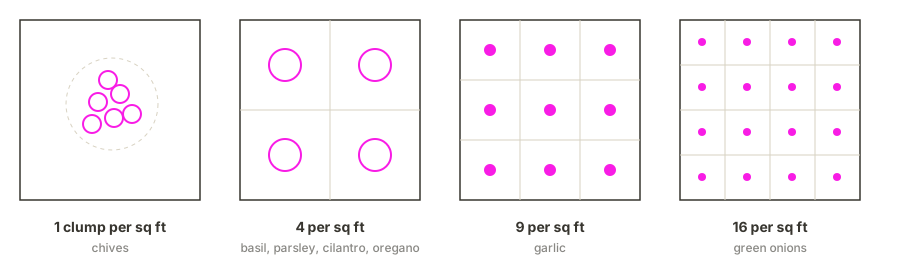
The rule that produces those numbers
Every count above comes from one conversion, and the same conversion covers herbs that are not on the list. From the extension notes: "If the seed packet recommends plant spacing be 12 inches apart, plant one plant per square foot, if 6 inch spacing; 4 per square foot, if 4 inch spacing; 9 per square foot, if 2 inch spacing; 16 per square foot."
So a herb whose packet says 6 inches gets 4 to a square, and one that says 12 inches gets a square to itself. Sage, rosemary and thyme are not in the notes, but their packets are, and running the packet number through this rule gives you a defensible answer without guessing. The same conversion is set out for vegetables in our square-foot planting chart.
One thing to watch: the rule is written for row spacing on a commercial seed packet, which assumes soil compacted by walking between rows. A square-foot bed is never walked on, so the packet number is usually conservative rather than wrong.
Chives are the question people actually ask
"How many chives per square foot" has no clean answer, because chives are grown as a clump rather than as counted individuals. Penn State Extension puts it in row terms: "About 6 chive plants, or a tight grouping of 10 to 12 plants, will fit in a 1-by-4-foot row."
Four square feet holding 6 plants works out at roughly 1.5 per square, and the tight-grouping version at 2.5 to 3. Neither looks anything like the 16 people expect from a small, grassy-looking plant. In practice, one square holds one healthy clump that you cut back repeatedly through the season, and dividing that clump every few years gives you the next one for free. Chives are propagated by division rather than seed for the same reason.
If you want a number to work with, plant one clump per square and treat 2 or 3 as the upper bound. Sowing 16 chive seeds into a square produces 16 seedlings that crowd each other into thin, weak growth.
Where 4 per square gets cramped
Four per square is right at seeding time and gets tight later, because several of these herbs are much bigger at maturity than their spacing suggests. Clemson's factsheet has basil growing up to 3 feet tall and oregano to 2 feet. Penn State names basil and dill among the herbs that "will need more space" than a standard row, and warns that "plants that are wide, such as sage, or those that spread on top of the ground, such as the mints, would be quite confined in a 1-foot row."
Two practical consequences. Sage and rosemary are shrubs, not annual herbs, so give each one a full square from the start and expect it to outgrow that within two seasons. And basil at 4 per square wants harvesting rather than admiring: pinching the tops regularly keeps it bushy and short instead of leggy, which is also how you get the leaves.
Mint is a container crop, not a square
Mint takes 4 per square like the other leafy herbs, and it should still never go into a shared bed. It spreads by runners and, in Oregon State Extension's phrasing, herbs like mint "need to be contained or they will overtake a garden."
The standard fix is to sink a pot: "Plant any potential runaways in containers, or plant in a container which you sink into the ground to just below the rim. Use a pot large enough to confine the roots for a couple of years." On a tiered frame that is even easier, because each tray is already a container. Just do not let a mint tray drain into a tray you care about.
Annual, biennial or perennial changes what the square means
A count per square is a snapshot. What matters over a year is whether the plant is still there next spring, and herbs split three ways on that.
Annual squares free up and can be replanted, which makes them the right place for succession sowing. Perennial squares are committed, so put chives, thyme and rosemary where you are happy to leave them, and keep the annual herbs where the traffic is.
Cilantro and dill have one more constraint: Oregon State advises sowing anise, coriander, dill and fennel directly into the garden "because they do not transplant well." Buying those as starts is buying a setback. Tarragon runs the opposite way, since true French tarragon can only be started from a cutting or a division.
Putting herbs on a four-tier frame
The Vertical Grow System's footprint is nine one-foot squares per tier, and the tiers differ in light. Herbs generally want full sun but, again from Oregon State, "will thrive on as little as 6 hours of sunlight per day," which puts most of them on the top two tiers.
A full top tier of basil at 4 per square is 36 plants, which is considerably more basil than a household eats. Most people give herbs two or three squares and put vegetables in the rest. Which herbs can share a tray with what depends on root depth and water demand rather than on the counts, which our companion planting chart works through, and the light bands are defined crop by crop in the sunlight requirements chart.
Feed them less than you think
Herbs are the one crop where more fertilizer makes a worse harvest. Oregon State is direct about it: the soil "does not have to be especially fertile, so use little or no fertilizer. With herbs, highly fertile soil tends to produce excessive amounts of foliage with little flavor." Chervil, fennel, lovage and summer savory are the exceptions and take moderate amounts.
Drainage matters more than fertility. Most herbs want well-drained soil at pH 6.5 to 7.0, and they stall or die in soggy soil. On a tiered frame that means checking that the tray above is not keeping the tray below permanently wet, which is the usual failure mode on a drain-linked system. General container feeding is covered in our container fertilizer guide.
Frequently asked
Four. The extension course notes from Mel Bartholomew's own class list basil at 4 per square, which corresponds to 6-inch spacing on a seed packet. Basil grows up to 3 feet tall, so harvest it regularly rather than letting all four fill the square.
Four, the same as basil, cilantro and oregano. Parsley is a biennial, so a square planted this year is still occupied next spring, when the plant bolts and goes to seed rather than producing usable leaves.
One clump. Penn State Extension fits about 6 chive plants, or a tight grouping of 10 to 12, into a 1-by-4-foot row, which is roughly 1.5 to 3 plants per square foot. Chives are grown and divided as clumps rather than counted as individuals.
Take the plant spacing off the seed packet and convert it. Twelve inches gives 1 plant per square foot, 6 inches gives 4, 4 inches gives 9, and 2 inches gives 16. Herbs bigger than the packet suggests, such as sage and rosemary, get a full square each.