Guide
Companion planting chart: what the research supports, and what fits a small frame
Most companion planting charts are copies of each other. This one separates the mechanisms that have been measured from the pairings that were never tested, then applies the part that survives to a 3-by-3-foot planter.
The mechanisms with evidence behind them
Trap cropping. A pest-preferred plant placed around the crop you care about pulls the insects off it. This is the best-documented mechanism in the whole subject. The UConn IPM program reports that perimeter trap cropping with Blue Hubbard squash around summer squash lowered cucumber beetle infestation by up to 95 percent and squash vine borer infestation by up to 88 percent, with the Blue Hubbard planted in rows completely encircling the central planting. Utah State University Extension ran the same idea against squash bugs at its Kaysville and Greenville farms in 2021 and counted significantly more adults, nymphs, and eggs on pumpkins in plots without the trap crop. Both write up the same condition: the pest has to be dealt with on the trap crop, by hand or by spray, or the trap crop just becomes a nursery.
Physical support and shade nursing. Washington State University Extension horticulturist Linda Chalker-Scott describes nurse plants as species that provide shade and moderate the microclimate for new germinants, and lists this among the benefits of plant associations documented through research. It is mechanical rather than chemical, which is why a tall crop beside a heat-sensitive one is worth arranging deliberately.
Nitrogen fixation, with a timing catch. Legumes fix nitrogen, and the catch is when the neighbors get it. New Mexico State University Extension puts the amount leaked into the soil during the growing season at roughly 30 to 50 lb of nitrogen per acre, and states that most of it returns to the soil for neighboring plants only when the legume's roots, leaves, and fruit die and decompose. Beans planted beside a tomato this season mostly feed next season's crop.
Marigolds and root-knot nematodes. The popular version of this claim is much broader than the research. UF/IFAS Extension's marigold publication finds French marigolds (Tagetes patula) most effective against the widest range of nematodes and names resistant cultivars against Meloidogyne incognita including 'Single Gold', 'Petite', and 'Tangerine', while Signet marigolds ('Golden Gem', 'Tangerine Gem') are susceptible to all three common Florida root-knot species. The conditions are strict: marigolds have to occupy the same ground the vegetables will, at least two months ahead of them, spaced under 7 inches apart, repeated every season. Asked whether interplanting marigolds among vegetables works, the publication answers "probably not", citing Powers et al. (1993), who found intercropping with marigold did not reduce plant-parasitic nematodes in Honduras. Marigolds also increase sting, awl, stubby-root, and spiral nematode populations, so the same planting that helps against one group hurts against another.
The Three Sisters. Corn, beans, and squash grown together is the one traditional polyculture with yield data behind it. Zhang, Postma, York, and Lynch measured it in Annals of Botany in 2014 and found a land equivalent ratio above 1.0 across nutrient treatments, the maize/bean/squash combination out-yielding maize/bean/bean by 17.8 percent on high-phosphorus plots and 15.5 percent on low-phosphorus plots. Their explanation is root architecture rather than chemistry: maize foraged relatively shallower, common bean explored the vertical profile more evenly, and squash root placement shifted with phosphorus availability, so the three together explored more soil than any of them alone. It is a field polyculture in open ground, and it does not transfer to three crops crowded into one 12-inch pot.
What extension services flag as unsupported
Chalker-Scott's review is direct: "There is no scientific basis, however, for any of the several lists that exist describing 'traditional companion plants,'" and her summary line is that traditional companion plant charts have entertainment, not scientific, value. She also notes a study reporting that traditional companion plants, aromatics such as Mentha species included, had little or no disruptive effect on insect behavior. That undercuts the most repeated claim of all, that strong-smelling herbs scattered through a bed drive pests away.
Basil next to tomatoes is worth singling out, because it is the pairing everyone names. The nearest thing to evidence is Yoshida and colleagues in Plant Cell Reports in 2024, who found that basil volatiles primed the tomato wound response, raising expression of jasmonic acid, MAPK, and reactive oxygen species genes, and that larvae fed on basil-exposed tomato leaves grew less. That was done in a controlled environment chamber at 23°C. It is a real effect on plant defense signaling, and it says nothing about flavor or yield. Sources disagree here, the pairing being settled advice in most garden writing and untested folklore in extension reviews, so the honest position is that the mechanism is documented in a growth chamber and unmeasured in a pot.
What actually decides whether two crops share a pot
In a container, the variables that decide the outcome are physical. The NC State Extension Gardener Handbook states the rule plainly: a container can hold more than one type of plant if all the plants have similar requirements for light, water, and nutrients. Water is usually the one that breaks first. Iowa State University Extension puts container watering frequency anywhere from once or twice a day in a small pot in hot, windy weather to once or twice a week in a large pot in cool weather, so two crops in one pot are locked into the same schedule whether it suits both or not.
Root depth is the second variable, and it is what makes a pairing work rather than merely survive. Two crops that both feed in the top 6 inches fight over the same water, while one shallow and one deep crop use different layers of the same pot, the container-scale version of what the Three Sisters study measured in a field. Our container size chart lists the minimum depth per crop, and those numbers are what the pairings below are built from. Height comes third: a 30-inch tomato shades an 8-inch lettuce for part of every day, a problem in July and a favor in a heat wave. Spread comes fourth, and it is why mint gets excluded from shared containers. NC State Extension's entry for spearmint says it spreads by rhizomes, roots wherever the stems touch soil, and is "best grown in a container as it spreads rampantly". That is a root-space argument, not an aromatic one.
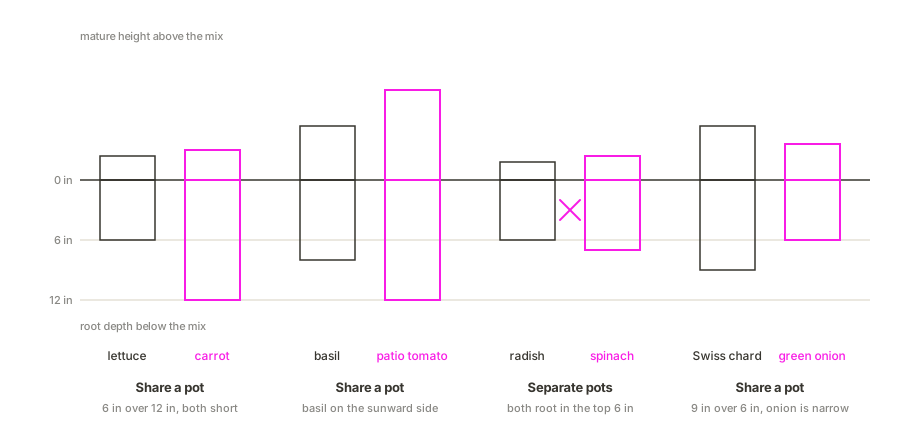
The chart: pairs that share a container on a 3-by-3 frame
| Pair | Root depths | Why it works |
|---|---|---|
| Leaf lettuce + carrot | 6 in / 8–12 in | Different layers, both short, same steady moisture. Lettuce is harvested before the carrots size up. |
| Swiss chard + green onion | 8–10 in / 6 in | Chard roots below the onions, and onion tops are narrow enough not to shade it. |
| Patio tomato + basil | 10–12 in / 8 in | Similar water demand and the same full-sun tier. Put basil on the sunward side so the tomato does not shade it out. |
| Strawberry + thyme | 6–8 in / 6–8 in | The exception to the depth rule: both are small, low-demand, and slow to fill a pot, so a 12-inch pot holds both. |
| Bush beans + a following leaf crop | 8–9 in | Sequence, not a mix. Cut the beans at soil level and leave the roots, then plant greens into that pot. |
Combinations to skip, and the actual reason
Tier placement does more work here than any pairing. A pair that fails on the top tier often works two tiers down, because the limiting factor was light rather than the neighbour. The hours each tier receives are in the sunlight requirements chart, and how many of each crop fit per square is in the square-foot planting chart.