Guide
Square-foot planting chart: how many plants actually fit per square
The footprint of the Vertical Grow System is nine one-foot squares. Square-foot gardening has a specific rule for how many plants go in each one, and it isn't always one.
The spacing rule
Square-foot gardening is a method the retired engineer Mel Bartholomew developed and published in 1981, built around dividing a bed into one-foot squares instead of planting in rows. It sorts vegetables into four size classes, and each class gets a fixed number of plants per square:
- Extra-large — 1 per square. Cabbage, broccoli, cauliflower, peppers.
- Large — 4 per square. Leaf lettuce heads, Swiss chard, basil, parsley.
- Medium — 9 per square. Spinach, beets, bush beans, bush peas.
- Small — 16 per square. Radishes, carrots, onions.
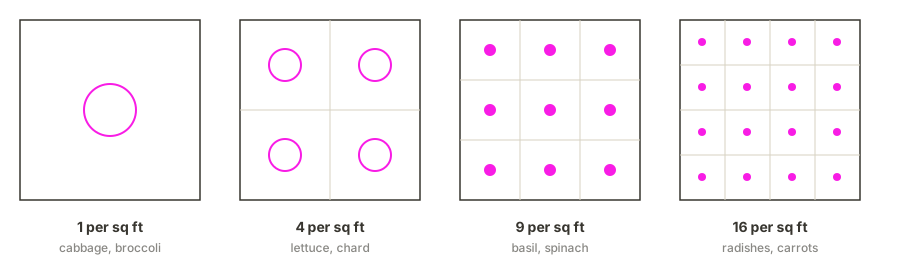
This is different from the seed-packet spacing on most commercial seed bags, which is written for row gardening and wastes space in a square bed. The square-foot count assumes plants touching their neighbors at maturity, which works because a raised bed's soil isn't compacted by foot traffic the way row-garden soil is.
Exact counts, crop by crop
The four-class shorthand above is the popularized version. County extension course notes taken from a class Bartholomew taught in person break the same method down crop by crop instead of by size bucket, and a few land in a different spot than the four-class summary suggests: basil and parsley come out at 4 per square there, not 9, while beets and garlic come out at 9, not 4 or 16. Neither number is wrong — spacing charts vary a little by source and by how tightly you're willing to crowd a given variety — but crop-specific counts are the ones to use if the four-class shorthand and a seed packet disagree.
Applying it to a 3-by-3-foot, 4-tier frame
The Vertical Grow System's footprint is nine squares. With four tiers, that's nine squares repeated four times, not thirty-six independent squares stacked freely: each tier is still one 3-by-3 layer, and what you plant in it depends on how much light that tier gets.
At those counts, a fully planted top tier holds 9 lettuces, the upper-mid tier holds up to 81 spinach or pea plants, the lower-mid tier holds 36 strawberry, basil, or parsley plants, and the radish tier holds up to 144. Most people plant fewer than the maximum, especially on the herb and radish tiers, to leave room to harvest without disturbing neighboring roots. Counts are only half the question, since whether two different crops can share a square depends on root depth, water demand, and height rather than on the counts, which is what our companion planting chart works through.
Why not just say "one crop per square"
Treating every square as a single planting slot is the easiest way to start, and it's a reasonable default for a first season. It undercounts what the frame can actually hold once you're comfortable spacing smaller plants closer together, which is the entire point of the square-foot method over row planting.