Guide
Balcony weight limits for planters, and why wet soil is the real number to watch
Every FAQ about balcony planters says "check your load limit." Here's what that limit usually is, and why the number on paper isn't the number you're actually working with.
What a balcony is built to hold
US residential building codes set a minimum live load for balconies and decks. These codes are published by the International Code Council, the nonprofit standards body behind the International Residential Code and International Building Code that most US jurisdictions adopt. Smaller residential buildings are commonly engineered around 40 pounds per square foot, while some codes call for 60 psf on balconies specifically. Taller or higher-occupancy buildings can be built to 100 psf. Live load covers everything temporary on the balcony at once: people, furniture, and planters together, not planters alone.
That number is set by the building's code and engineering, not by the planter you buy, so it varies by building age, height, and jurisdiction. A property manager or the original building permit is the only reliable source for your specific balcony.
Why the number changes between a house and a condo
The 40, 60, and 100 psf figures above aren't points on one sliding scale — they come from two different code documents. The International Residential Code, which covers most single-family houses, sets a flat 40 psf minimum live load for exterior decks and balconies. The International Building Code, which covers condos, apartment buildings, and other multi-family structures, uses a different formula: balconies and decks are engineered for 1.5 times the live load of the room they open off of, capped at 100 psf. Run a typical residential room's 40 psf through that formula and you get 60 psf, which is why a condo balcony is often rated higher than the living room behind it, and why both 60 and 100 psf show up in balcony discussions without contradicting each other. A house built under one code and a mid-rise built under the other can end up with genuinely different numbers for what looks like the same kind of balcony.
Why wet soil changes the math
Potting soil gets heavier when watered, sometimes by close to half its dry weight. A planter that felt manageable dry can sit noticeably heavier after a normal watering, and it stays at that wet weight most of the time it's in use. Weigh or estimate a planter's load in its watered state, not the state it shipped in.
A rough rule that leaves headroom for people and furniture sharing the same balcony: keep planter load in the range of 15 to 20 pounds per square foot of balcony floor, well under the 40 psf baseline most codes set, rather than trying to use the full rated limit for plants alone.
Where to place the weight
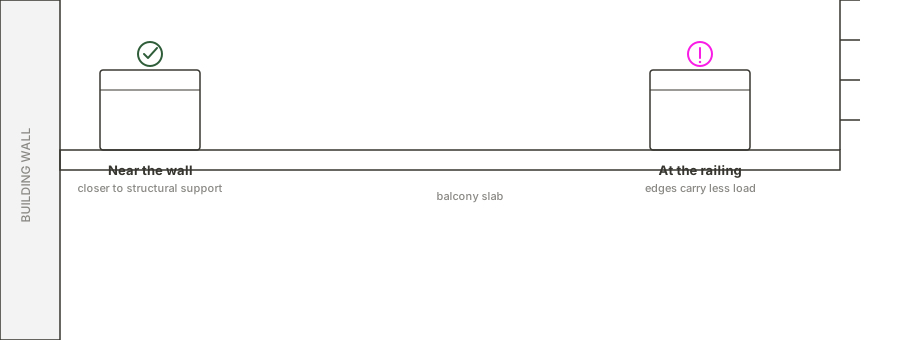
Balcony edges and railings aren't always designed to carry concentrated load the way the slab near the building wall is. Set heavier planters close to the wall or the balcony's structural supports, and avoid clustering weight at the railing or in a single corner.